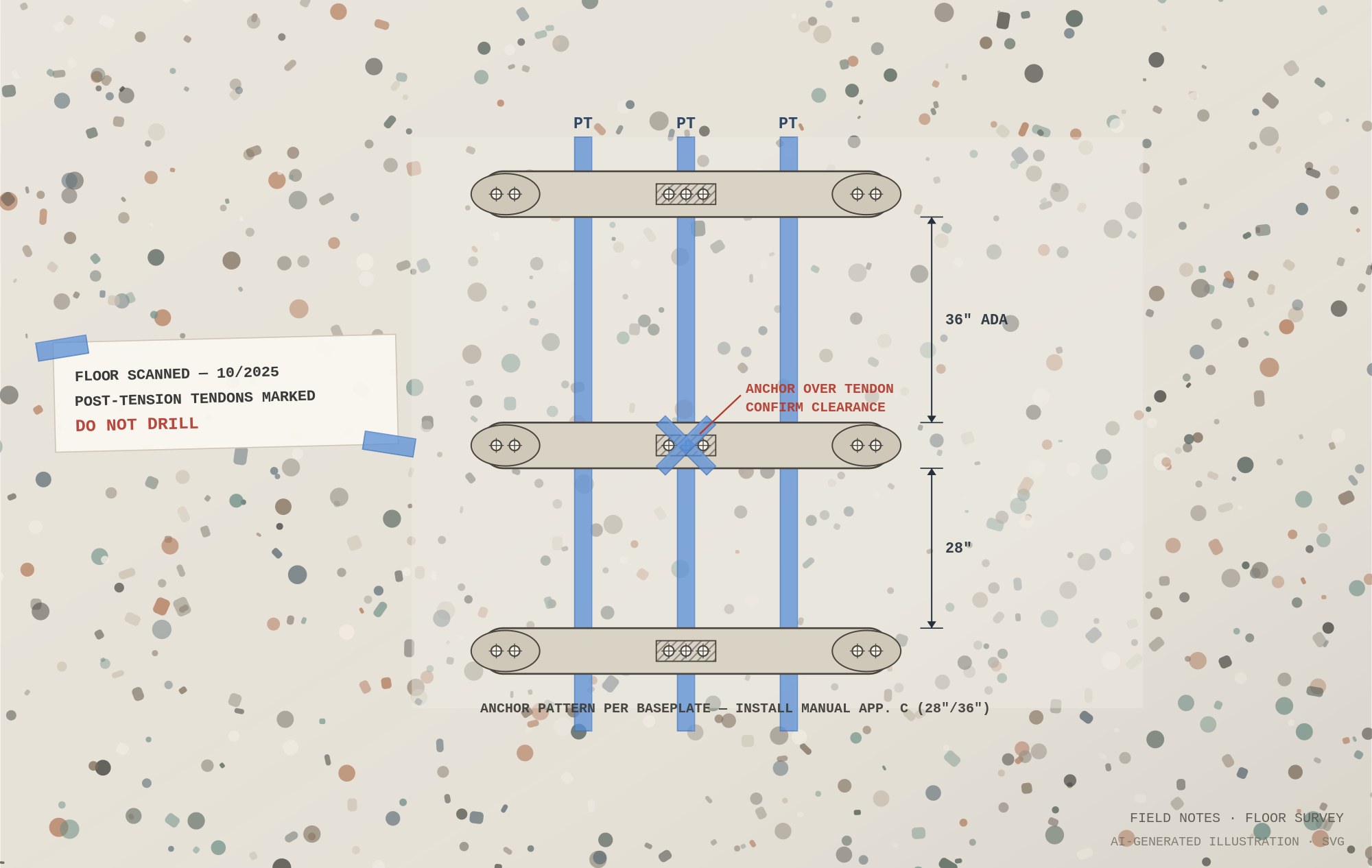
AI-generated illustration (SVG). A scanned, marked-up post-tension floor — the tendons run under the tape.
The job
A downtown high-rise office floor, fall of last year. The scope was small: a couple of lanes of Alvarado optical turnstiles going in at a lobby entrance — the kind of gear that lives or dies on how well it's bolted to the slab. We rolled in with a crew of three. Two of us could have done it. It was not a complicated job.
It stopped being simple the moment we looked at the floor.
What we found
Somebody had been there ahead of us. The slab was marked up — lines and notes where a scanning crew had x-rayed the floor and mapped what was running through it. We didn't have to guess what we were looking at. The floor was post-tensioned, and the marks were telling us where the cables ran.
That's the whole job, right there. We don't drill post-tension floors. That's not a judgment call I make fresh on each site — it's a flat rule. You do not free-hand an anchor into a post-tensioned slab, and you don't drill one on someone's say-so, period.
So I told my contact on site the truth: this part is beyond us. Here's the path forward — you get the holes drilled by whoever owns that risk. We'll set the equipment in place first, mark exactly where the anchors need to land, and come back in the morning to bolt everything down once the holes are in.
The standoff
That did not land the way I'd have liked.
It kicked off a back-and-forth between the client and the office I was working through. Neither of them really knew what a post-tension cable was. They saw a floor and a drill and a schedule, and they wanted the holes drilled now. It took some explaining — and then it took pulling in somebody higher up the chain, who heard it out and said exactly what I'd said: no, we will not drill that floor.
And it's not improvised. The outfit I sub through runs a site survey before a job like this — sometimes it's a formal walk, sometimes it's a few questions over email with the client filling in the blanks — and one of those questions exists for exactly this reason: are there cables in the floor? You ask it before anyone's standing on the slab with a hammer drill and an argument.
A quick sidebar before we get back to it — what's actually in a floor like this.
The morning after
We came back the next day. The holes were in — the client had arranged to get them drilled overnight.
When I looked at where they'd landed, the holes sat closer to the marked lines than I'd have wanted to drill myself — they usually do, when the anchor pattern is fixed and the cables aren't. But they'd laid it out against the marks, the bits cleared the cables, and it held. I was just glad it wasn't my hand on the trigger making that call.
But nothing got hit. The anchors went down, everything torqued up clean, the lanes commissioned, and we were out. A good outcome — and the part worth sitting with is whose outcome it was. The people who owned the floor and the schedule are the ones who took on the risk I wouldn't. That was theirs to take. They own the rules on their floor; they own what happens when they drill it.
Who owns it
There's a version of this where I'm the agreeable guy, drill the holes myself to keep the schedule, and it goes fine ninety-nine times out of a hundred. The hundredth time, close isn't clear, and the name on the drill is mine.
The lesson isn't "be afraid of concrete." It's that the risk belongs to whoever owns the rules and the specs — and your job, when the floor in front of you is one you shouldn't touch, is to put that risk back where it belongs and get it in writing. Ask the question before you mobilize: is there anything in this floor? Make the client or the GC answer it. If the answer is post-tension and nobody will own the drilling, then you stage, you mark, you hand it back — or you walk.
It points at something bigger than one floor, too. The as-built drawing is the only record that travels with a building for its whole life, and our trade treats it like a nice-to-have. On any drill, anywhere, the first question is show me the as-builts — and the second is who confirmed they still match the slab.
You don't have to win the argument about what's under the slab. You just have to not be the one holding the drill when it lurks below.
Two reference sidebars to close — what it costs to do it right, and what the rulebook actually says.
A note on what this isn't
This is my view as a field integrator with decades on the trade — not engineering or legal advice. Whether and how you drill near a post-tensioned slab depends on the structure, the drawings, a qualified scan, and the people licensed to sign off on it. If you're facing a floor you're not sure about, stop and get a certified concrete-scanning operator and the engineer of record involved before anyone drills. The cost figures and standards below are current as of writing and meant to show the shape of doing it right — not to substitute for a real scan on your actual floor.
References
Ground Penetrating Radar Systems (GPRS). (n.d.). Ground penetrating radar: Should you rent, buy, or hire? https://www.gp-radar.com/article/ground-penetrating-radar-should-you-rent-buy-or-hire
Hilti. (n.d.). PS 1000 X-Scan concrete scanner. https://www.hilti.com/c/CLS_MEA_TOOL_INSERT_7127/CLS_CONCRETE_SCANNERS_SENSORS_7127/r6436760
Leica Geosystems. (n.d.). C-thrue concrete scanner. https://shop.leica-geosystems.com/utility-detection/concrete-scanner
Occupational Safety and Health Administration. (n.d.). 29 CFR 1926.701(c) — Post-tensioning operations. U.S. Department of Labor. https://www.osha.gov/laws-regs/regulations/standardnumber/1926/1926.701
Post-Tensioning Institute. (n.d.). Technical notes and field guidance for existing post-tensioned structures. https://www.post-tensioning.org/
Post-Tensioning Institute of Australia. (2014). Post cut holes through post-tensioned slabs (Guidance Note GN06 v.2). https://www.ptia.org.au/wp-content/uploads/PTIA_GN06V2_PostCutHoles-through-Post-Tensioned-Slabs_Dec14.pdf
American Society for Nondestructive Testing. (n.d.). Recommended practice no. SNT-TC-1A: Personnel qualification and certification in nondestructive testing. https://www.asnt.org/
Occupational Safety and Health Administration. (n.d.). Accident report 126008770 — Employee is killed when struck by post-tensioning device. U.S. Department of Labor. https://www.osha.gov/ords/imis/accidentsearch.accident_detail?id=126008770
Structure Magazine. (2018). Post-tensioned concrete construction. https://www.structuremag.org/article/post-tensioned-concrete-construction/